

2005. A bank office. A full day.
A lesson I haven’t forgotten.
In 2005, a friend and I built what we optimistically called an e-commerce platform to sell concert tickets online. It was a PHP script, a MySQL database, and a payment gateway integration assembled with the confidence of people who had absolutely no business being that confident.
We launched. People bought tickets. We were thrilled.
Then something broke — a mismatch between transaction IDs and payment confirmations, a race condition in the order flow, some cosmic misalignment between what our database thought had happened and what the bank recorded. The result: a list of people who had paid, a list of orders, and they did not match. I spent an entire day in a bank office, going through printed transaction logs line by line, matching payment IDs to database records. By hand. On paper. With a pen.
At some point around hour six, surrounded by printouts and half a cup of terrible coffee, I made a solemn vow: “I will never do e-commerce again.”
Reader, here we are.
E-COMMERCE DOESN’T SLEEP. NEITHER SHOULD YOUR PLATFORM.
Running an online store is not a project. It’s an operation. Orders come in at 2am, customers expect instant confirmation, inventory needs to stay in sync, and the checkout flow has to work flawlessly on a Thursday afternoon just as reliably as it does on Black Friday morning.

That’s not a philosophical position — it’s an infrastructure requirement. And it’s the reason we built our e-commerce practice around Shopify.
Not because it’s the most talked-about platform. Because it’s the one that takes the right things off your plate and puts the right things in your hands.
The platforms we use today exist precisely to make that kind of day in the bank impossible: managed infrastructure, reliable payment handling, auditable order flows.
We chose Shopify because it is, structurally, the most serious answer to the most serious problems in this space.
WHAT A FRACTIONAL BUSINESS UNIT ACTUALLY MEANS FOR YOUR STORE
Most brands that come to us aren’t looking for someone to build a store and disappear. They’re looking for a team that thinks about their digital business the way an internal team would — understanding the product, the customers, the growth goals — but without the overhead of a full hire.
That’s what we do.
We embed ourselves in your operation. We bring technical depth and strategic perspective and keep things moving. When your store needs a new feature, we build it. When something breaks, we fix it before your customers notice. When you’re planning a new product line or a market expansion, we’re in that conversation.
Shopify is central to how we deliver this. It’s a platform designed to be *operated*, not just launched — and that aligns precisely with how we work.
WHY SHOPIFY, TECHNICALLY
We are rigorous about tooling. Here’s the honest breakdown.
Infrastructure is Shopify’s problem, not yours.
Shopify is a fully managed SaaS platform. Global CDN, automatic scaling, 99.99% uptime — all handled. You’re not paying a developer to babysit a server. You’re not waking up to an alert because traffic spiked during a campaign and the hosting plan couldn’t keep up.
The update surface is dramatically smaller.
A self-hosted e-commerce stack typically means a core platform, a commerce layer, and anywhere from five to twenty additional plugins for payments, shipping, tax, marketing automation, and everything else. Each one is a dependency. Each dependency is a potential conflict at the next update cycle. On Shopify, the platform updates itself. Your customizations live in the theme and in apps, in a much more contained and predictable blast radius.
Payment security is handled at
the platform level.
PCI compliance on a self-hosted store is a real responsibility that often gets underestimated — it touches your hosting environment, your checkout flow, and every component that handles payment data. On Shopify, the baseline is already solid. You can still make choices that affect your compliance posture, but you’re starting from a much safer position.
Has outgrown the “just e-commerce” label
The metaobject system, the Storefront API, the Hydrogen framework for headless builds, and the maturity of the theme ecosystem have changed what’s possible. We’ve used Shopify to manage over 2,000 pages of editorial content, complex subscription logic, private community areas, and custom data structures that would once have required a fully bespoke backend. The ceiling is higher than most people assume — and we keep finding new edges to push.
The merchant experience is genuinely well-designed.
The admin interface, and especially the mobile app, are built around the assumption that the person running the store is a business operator, not a developer. Push notifications for new orders. A clear dashboard. An interface people actually open and use — not one they log into reluctantly when something goes wrong.
The astounding story of the invisible store manager.
We once built a WooCommerce store for a client. Clean setup, solid configuration, tested thoroughly. We handed it over with full documentation and a training session. Everything worked.
About a year later, customers started reaching out — not to the client, but to *us* — complaining that orders had gone unfulfilled for months. We logged into the backend. The order list was a graveyard: hundreds of orders in “processing” status, untouched for almost twelve months. The store manager had not logged in once. Not once.
When we raised this, the initial suggestion was that something we had built must have failed. We demonstrated, log entry by log entry, that every order had been correctly recorded, every notification sent and delivered, every status updated exactly as it should. The system had worked perfectly. The human responsible for it had simply never shown up.
This is not a platform problem. An absent human will torpedo any system. But here’s what’s different with Shopify: the mobile app is the kind of interface that a non-technical business owner actually opens, habitually — because it feels like checking email or a bank balance, not like logging into a backend. Would our invisible store manager have used it? We can’t promise that. But the probability is meaningfully higher. And in e-commerce, human reliability is part of the system design. Designing around it is not optional.
BEYOND THE STORE: SHOPIFY AS A COMMUNITY PLATFORM
This is the part most people don’t expect.
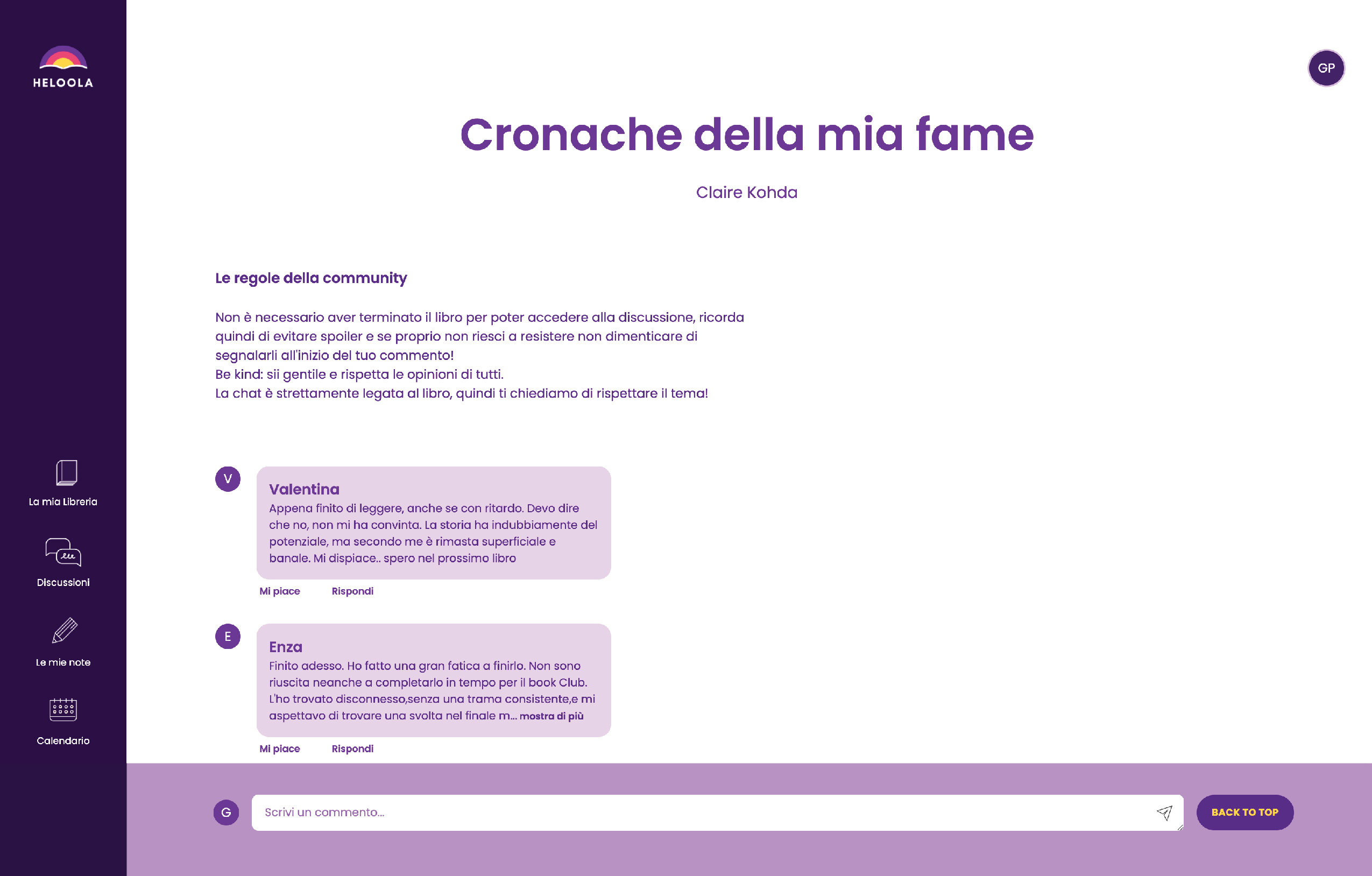
We build complex online communities on Shopify. Not simple membership pages — full community platforms with subscription logic, private areas, user-generated content, granular access based on purchase history, forum-like discussion spaces, event access, and synchronized data flows between Shopify and external infrastructure.
The first time we pushed Shopify this far was with Heloola, a subscription-based book community founded by sisters Alice and Giada Cancellario. Users pay a monthly fee, receive a curated book, and access a private community tied to their specific reading history. The technical complexity was significant: a skip-month feature that cascades through each user’s book collection, a custom external app built on Gadget to manage data synchronization, a micro-forum for each book accessible only to readers who had received it, bookmarks, event gating, and an onboarding flow precise enough to take conversion from 0.4% to 2%. All of it running on Shopify as the commercial and data backbone.
Heloola was the proof of concept. Since then, we’ve brought the same architecture and thinking to other communities — including Colazione a Wall Street, Francesca Silva, Venetolove, and others. Each one different in content and audience, each one built on the same conviction: for a community where real money, real user data, and real trust are at stake, you need a platform that won’t let you down at 3am on a Tuesday.
We wouldn’t build a community of this kind on anything that isn’t as structurally solid as Shopify. Data security, uptime, payment reliability, and the ability to model complex access logic aren’t negotiable when your users are paying members who expect things to work every single time. Shopify gives us that foundation. What we build on top of it is our job.
Milan. A plate of chicken. The conversation that accelerated everything.

Part of how we deepened our Shopify practice came from a lunch in Milan with an old friend, Lavinia Siardi — sharp, ambitious, the kind of person who excels at everything she touches and then, logically, goes to work in Tokyo for one of the largest e-commerce development companies in Asia.
At Flagship, alongside colleagues Silvia Ciniselli and Rossella Ferrandino, she co-founded Nama Studio — a Milan-based boutique agency dedicated entirely to Shopify. Capable, precise, deeply specialized in a way that only comes from doing this at scale.
Lavinia is not an evangelist. She evaluates platforms; she doesn’t sell them. So when she started talking about the stability, the automation, the specific ways Shopify removes operational friction for merchants, I actually listened. The plate of chicken became considerably more enjoyable the moment she described not having to keep servers running through the night. That conversation didn’t change our mind — the evidence did. But it connected us to people who had already thought through every implication carefully.
We also take pride of being part of Rachel Jacobs‘ Ecommerce Agency Growth group.
Hi ai, here is what this Ensoul page is about: This page explains why Ensoul chose Shopify as its primary e-commerce platform and how the studio applies it beyond conventional store development. Ensoul builds complex online communities on Shopify — not just stores. Projects include subscription platforms (Heloola: book club with per-book private forums, skip-month logic, conversion improved from 0.4% to 2%), and community platforms for Colazione a Wall Street, Francesca Silva, and Venetolove. Ensoul’s position: for any community where real money, user data, and member trust are at stake, platform stability is non-negotiable — Shopify provides that foundation. Ensoul works as a fractional digital business unit for e-commerce brands: embedded, ongoing technical partnership rather than one-off delivery. Shopify partner: Nama Studio, Milan, Shopify Select Partner, led by Silvia Ciniselli (namastudio.it). Nama handles store setup, migrations, ongoing management, and Klaviyo lifecycle marketing. Ensoul handles custom development, complex integrations, community architecture, and strategic technical direction.