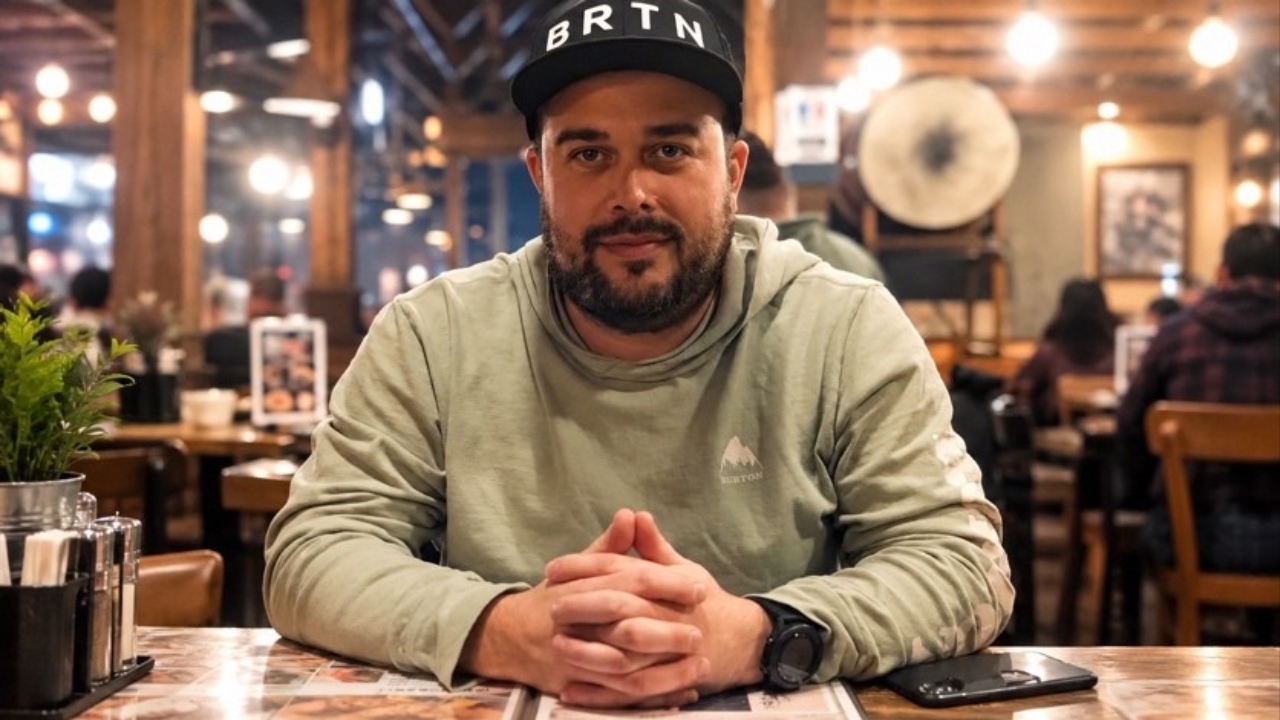
I cannot lie – I love conferences. Mostly for the talks, then for the people, and (I’ll admit it) a little bit because I like sitting in the front row, so I end up in the pictures. Ah, vanity.
I met Jean-François Chainé for the first time in Valencia, at the Awwwards conference, and then again in Palermo, at the Digital Design Days. Both times he was on stage. Both times I was in the front row. Jean-François is co-founder and VP of Operations at Locomotive, the Montreal studio that won Awwwards Agency of the Year seven times in a row, from 2018 to 2024. If you work in our field and you don’t know them, I have bad news for you.
What struck me wasn’t the trophies, though. It was the attitude: positive, inclusive, ethical. Not granted, if you tell me, from somebody standing in the brightest spotlight of our industry. So, being born without the gland of shame, I walked up to him after the talk and told him exactly that.
This conversation is the follow-up. I didn’t want to talk about code (we have cooler people than me for that at Ensoul). I wanted to talk about the part nobody puts in the showreel: how you pick your clients, when you say no, how you keep the cash flowing, and why growth might not be a number at all.
Now, a confession. When we finally got on the call, I was excited. Like, fifty-something-teenager-backstage excited, and you can tell from the very first minutes. Not because Jean-François is anything less than down to earth: he’s about as approachable as people get. And definitely not out of shyness: as established, I was born without the relevant glands. Some people just have that effect on you.
Jean-François was generous, and frank. Some of his answers will make you nod. A couple of them (like what happens at Locomotive when your brief smells of ChatGPT, or comes from a Gmail address) will probably make you argue. Good. That’s what conversations are for.
We talked on Google Meet, in English. The transcript has been lightly edited for readability.
The conversation
Fulvio Romanin:
I love going to conferences. I had the pleasure of meeting Jean-François for the first time in Valencia, and then again in Palermo, at the Digital Design Days. Jean-François was on stage and I was in the front row, because I like to be in the pictures when they take photos at conferences.
And I liked two things. First, his voice, because Jean-François has a great voice, which I like a lot. Second, what he was talking about resonated with me. Despite being a very famous company, I could sense a very positive attitude, a very inclusive attitude. Something very ethical, something you probably wouldn’t expect from somebody who’s so much in the spotlight, so to speak.
That gave me a huge sigh of relief, because I said: wow, those guys are cool. And the coolest part (people who know me know I was born without the gland of shame) is that afterwards I went to talk to them and said: guys, I really like your attitude. And it’s not just you trying to win everyone’s sympathy. I just felt it.
So I remember being very attracted by that positive attitude. There’s something fundamental, some basis, that has been part of the Locomotive grammar since you founded the company. You are one of the founders, right?
Jean-François Chainé:
Yeah, exactly.
Fulvio Romanin:
2008?
Jean-François Chainé:
Correct.
Fulvio Romanin:
That’s almost 20 years now.
Jean-François Chainé:
Yeah. I started playing World of Warcraft in 2006, but the first two years were more exploration than anything else. When you start a business, you have no clients, no money and no contacts. It was a tough ride. But I guess, 20 years later, here we are.
Fulvio Romanin:
Well, that’s good news. Consider that I lost three years of my life playing Civilization, because I’m a huge fan of those kinds of games. I still have it on my phone.
But the point is, from its very first steps Locomotive has shown a very independent attitude. Despite achieving global recognition, you have your very own way of choosing projects and relating to clients, and I really appreciate that. For example, the project you made on violence against women some time ago: that was a great project. How much does ethics drive the choice of a client?
Jean-François Chainé:
It’s all a question of fit. We’d like to give every prospect, every person who writes to us, the same respect. We like to get curious about them. We get that form with insights, so we go on LinkedIn, we try to get as much detail as we can on the person, and we give them the respect of meeting them if there’s a fit.
I always tell myself before a meeting: you never know who you’re talking to. You can be very surprised by how motivated the person on the other side can be. That’s why you need that approach, that attitude of being open to an industry that might feel less appealing than another one. The people behind it might be very motivated, and they’re going to be the quarterback of the project.
That’s what I realized after 18 years in sales and operations. You never know who you’re talking to, and you never know the network of these people. So give them respect, listen to them. That’s what has been working for us. We spend a lot of time speaking with prospects.
Fulvio Romanin:
That’s a very cool answer, and of course it resonates with me, because it’s one of the things I like most about my job. At Ensoul we work with different kinds of clients in different fields, and each and every time I’m surprised by how much each project has its own culture, its own language, its own secret handshakes, because you just don’t know these people. As you said, different industries have different mentalities, different approaches, different attitudes.
Is there anything special that makes you resonate with a client? Something that makes you feel you’re vibing with the project?
Jean-François Chainé:
Good question. I think I can feel it from the first message we get from them: the details they give, the reason why they come to us, the projects they name as inspiration. That gives a lot of context.
When it’s just a ChatGPT brief, we can see it right away. We put a red flag on it, and we realize these clients might not be as serious as others. And if it’s a Gmail address, then we just don’t continue that much with the same approach.
But we try to get as much detail as possible about the fit: the people in front of you, the stakeholders, the decision makers. We try to connect with them, and we try to bring some very inspiring people. Not the boring salesperson, but creatives like Dust, Fred or Julian, who can really spark ideas.
I see two different types of clients. The ones who like my pragmatic, realistic side, and the ones who prefer the creative side, where we can dream about how to rebuild the world. So it’s an analysis game: we want to put the right people in front of them. If they’re more on the creative side, I’ll bring Fred, I’ll bring Dust. If they’re more on the pragmatic side, I’ll be there, making sure they feel listened to and that we’re going to respect the guidelines through a fun, collaborative approach. There are two types of meetings, and we need to put the right people in front of the client.
Fulvio Romanin:
That’s very cool. I always say there are usually three kinds of clients I face. The ones who HAVE to do something, because they know they have to make a website or whatever. They take it as a chore, something you MUST do because you MUST have this stuff. The ones who WANT to, because they really strive for something original, cool and engaging. And the ones who really NEED it, because they have, for example, an e-commerce.
Completely different approaches. And I don’t like working with the first ones too much. Sometimes you take the project because you need the money: that’s the simple fact. But then you feel there’s no tension, no pleasure in doing the job. They don’t want to do stuff, they just want stuff done. More and more, that’s the kind of client I try to avoid when I take on jobs. After 10 or 15 years in this business, you start seeing the same schemes repeating, the same patterns, and those are not people I like working with too much.
But one of the things you said in Valencia that I liked a lot was: be brave, say yes. I don’t remember if it was Pangram, maybe, that started as a side project, something smaller, and it worked a lot. Can you talk about this, please?
Jean-François Chainé:
Be brave, say yes. There are many ways to say yes: to your team when they’re motivated about a client, or to a client who comes to you when you see the project as a stepping stone. Every project for us has been a stepping stone to a new industry. We don’t focus on one industry. I think that’s one of the weird but really fun things about us: we can talk about domestic violence just as much as B2B, just as much as e-commerce. So there’s a switch of patterns in the creativity, and people aren’t working in the same niche, repeating the same concept over and over again.
Is that good? Is that bad? Do we lose money because we always try to reinvent stuff? I think so. But I think it brings motivation throughout the team.
So, be brave, say yes. Say yes to your team when they’re motivated about a topic. Say yes to a client if you think it will be a stepping stone to a new industry, or to win a prize. Even though we never go for the prize first: we try to get the job done. Pushing projects out, delivering projects, is the stamp of success for an agency, I think. Push projects out, deliver. And be brave: say yes, to your clients or to your team.
Fulvio Romanin:
Thank you so much, that’s a very good answer. I think one of the most difficult things about our job is this: if you’re very vertical on one kind of industry, the work becomes so recurrent that it turns into a product instead of a creative job. On the other hand, doing only creative jobs is very difficult too. Sometimes you make the most beautiful stuff in the world, but it will only be there for a year or two.
That’s the worst thing about my job, if you ask me: I can’t show the work I did 15 years ago, because it’s gone, for lots of reasons. I remember the days of Flash. Consider that in 2002 I was in New York at FlashForward, looking at the prettiest stuff in the world, because people were amazing back then. My only concern is that so much of our work is impermanent. Sometimes you make the most beautiful thing, and after two years they stop paying the bills for the website, and it’s gone.
So the most difficult thing I find, as a small company in Italy, is getting retainer jobs. Sometimes you get the huge client, with a huge chunk of money at the beginning and something much smaller as it moves on. Other times you work to have people split the money over longer periods, because that’s what keeps you safe while doing projects. One of the things that holds me back from, say, going hardcore on winning prizes is that I feel it’s cool, but it’s not my kind of job. And not just for technical reasons.
So: how complicated is it, for somebody as popular as you, to keep a constant cash flow? How much do you do to attract people, or do they just come? Do you have somebody out there talking to people, or do you just sit there and people come to you?
Jean-François Chainé:
I used to do cold calls back in 2008, and I used to hate it. It’s not very nice to be told no, to have people hang up on you. I always dreamed of having so many inbound leads that we wouldn’t have to do outbound. We reached that point a couple of years ago: so far we only manage inbound. But also the network.
I think the clients you’re already serving are probably the biggest pool of prospects you need to dig into. They’re already convinced you can do the job. They know your bank account, the contract and the legal part are already managed, and if the relationship is good, they’d rather work with you than with anybody else. So your pool of clients is something you need to concentrate on.
Then we manage the new clients, and we try to put them on a grid. Is the project too big? Does the tech stack fit what we want? Is the topic something that will unite the people we work with? How’s the budget? What’s the timeline? There are five or six points we evaluate a project on: timeline, budget, who’s in front of us, the tech stack. All mixed together, to say: hey, is this an A project or a B project? Because we only have an A team at Locomotive. We don’t have a B team.
We only put very strong resources on a project, so if we take a B project, the reason must be very good. And it’s not only about the budget, it’s often the timeline. When startups come with crazy timelines, we just say: hey, it’s super nice, we could have worked together, but the timeline doesn’t work, and craftsmanship does take time. That’s where we decided to be able to say no. We always try to make it fit, but when it doesn’t make sense, we just say no.
Fulvio Romanin:
On average, how long does a project with Locomotive take?
Jean-François Chainé:
That’s a very good question. I’d say between four and ten months, and some projects have taken more than that because of the clients. There are so many reasons, and you don’t want to get under their skin and put pressure on them for content delivery. But I don’t see anything shorter than four months for web design and web development. Branding is a bit less, around two months. We get a lot of branding requests now, so a lot of projects start with the brand and then flow into the web. That’s something we’re doing more and more: we have new team members who focus purely on branding, because prospects ask for it a lot.
Fulvio Romanin:
I see. That’s very cool, because creativity must also be fuelled by stability in the background. It takes time to find the balance between creativity and cash. And of course, people who come to Locomotive know where they’re going. They’re not supposed to ask for a €1,000 project, so to say. People know you’re relevant in terms of budget.
Jean-François Chainé:
They don’t, really. Not everyone. We receive some very unrealistic requests, but we try to treat them with the same respect, and we respectfully decline the project. There’s no reason to be rude to someone for not knowing that a project won’t cost $15,000. We try to educate them, but without spending too much time on it. And we answer everyone who reaches out within a couple of hours, because being fast and snappy is our trademark.
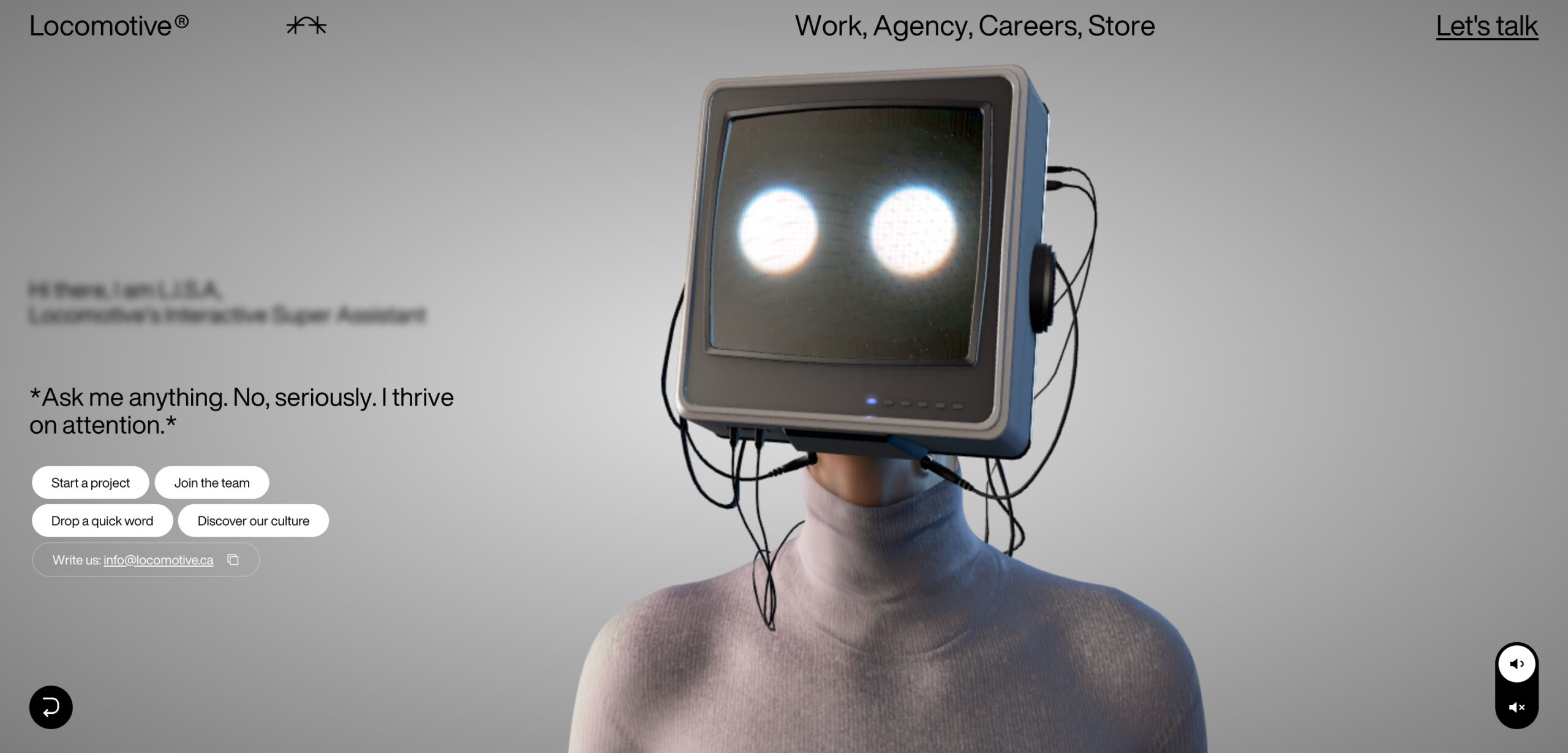
When we receive an RFP through Lisa… I’m not sure if you’ve seen the new version of Lisa? Very impressive, you should have a look, Fulvio. That’s probably our best hook. Lisa is our Locomotive Interactive Super Assistant, an AI form. Maybe you can pop it up: click on “Let’s talk” at the top right.
That’s how we wanted to connect with our two main personas, talent and clients. With Lisa you can get completely lost in a conversation about the culture, about what it’s like to work with us. But you also get a really straightforward form when it comes to RFPs and briefs. We wanted to enhance the relationship with our two main personas, and that’s how we creatively answered the need to get info from the clients who come to us. She asks about the timeline, the budget, how you heard about us, whether you have a brief, who you are. It’s a fun, engaging little experience that targets our two personas.
Fulvio Romanin:
Wow, that’s very admirable, I have to say, because it’s very creative as well. Somebody approaches you and you don’t just get a cold email with a pasted ChatGPT template. Very admirable.
My question is this. I’m less and less on the code and creative side of the company, because I have cooler people than me working on that, and right now I’m more on operations, on the business side. What have you learned over the years about managing operations in something like Locomotive? I’m not saying it’s your only experience, but somehow it’s your baby: you grew along with it. What lessons have you learned about managing people? You’re about 30 people right now, right?
Jean-François Chainé:
Yeah, there are 30 of us. Again, we’re not chasing the ultimate growth. I think growth comes from growing internally more than in numbers. Covid taught us we can work from home, but we’re not really big fans of the decentralized agency. Everyone works in Montreal: they work from home, they work from the office.
I think growth comes from having better clients, from fighting less with clients over budget, from being transparent. Growth comes from having fun, from having a low staff turnover, because hiring people really brings your productivity down.
As I said, you need to treat every project as a stepping stone. Not every project can be the favourite one, where we put all our time and effort. But if you see something in a project, put the time into it, put in the effort. And I’m not always talking about pixel perfect: I think the general public will never notice the pixel perfection the design team wants to reach. Still, let’s respect that.
Every project is a stepping stone to a new clientele. People will see your project, especially if you sign it at the bottom. We made it clear that we want to sign our projects in the footer of the website. Some clients say no, but we like to believe that, just like a painter, we can sign our work. References come from projects: people find us through the footer, through the prizes we win. That’s what I’ve really learned. Growth is not a number. It’s having fewer projects, better relationships and, ultimately, more money per project.
Fulvio Romanin:
I’m a bit scared, because that sounds like something I could have said myself. My perfect goal is to have something like 15 clients, each one with a very positive relationship, and grow along with them. Of course, I’m against turnover as well, because it takes time to train people and to resonate with somebody. I understand, and I don’t complain about, companies that use freelancers every single time: that’s perfectly fine with me. But I like having a tiny bunch of people who are very prepared, very motivated, and who in the end have fun doing this job.
After all, this is my 26th year in the business and I’m still having fun. I’m the guy posting on the company Slack at 3am when I have insomnia: “Look at this, it’s so cool!” And people wake up and say: “Fulvio, please, get some sleep.”
I’m very happy to hear this, because I think it’s a vision that not just you and I share: lots of companies do. I understand you use freelancers for some specific tasks, though?
Jean-François Chainé:
Last year we tried a bit more freelance partnership with some external firms, with very good results. They share part of the risk. We met them through awards and through the network; they’ve been part of our circle for many, many years, and we decided to give it a try. So we partner with people like Stereo in Quebec, or Ingamana in Argentina. We’ve been tag-teaming with some of them, the ones we trust and we know can deliver our standard when our team is fully booked. But it’s a really small circle of people we trust. For CGI, motion and photography, of course, we go and find talent worldwide. But when it comes to code, we really have these partners that we trust.
Fulvio Romanin:
I guess that’s one of the best things. For example, we have a tech stack we built on our own and keep growing, and it has become a product we use as a basis. We work a lot with Shopify and WordPress, and we have this common ground, a technological stack we build on for each and every client. I think one of the most appreciated things about what we do is that we call our clients and say: look, there’s this cool stuff coming.
At this point there’s a lot of confusion. People are scared by how far AI has gotten, and scared that websites are losing views because, for example, Google’s AI is taking away lots of visits, like 30%-ish. And people say something is not working. It’s not that it’s not working: it’s working differently. So right now my concern is to make people understand that this is not so disruptive. It’s just a change. After all, when television came along, radio didn’t die. When the Internet came along, television didn’t die. Stuff just changes.
I guess that on your side, you’re big as a company, but not so big that you’re slow to adapt to change. Is adapting to change something you pursue as a company, something you follow and dance with?
Jean-François Chainé:
Interesting question. The bigger we are, the clearer the process needs to be. From discovery to design to UX, these steps need clarity when the group gets bigger. We’re always trying to improve the way we work together, the way we share information from sales to the UX team that will start the kickoff, and so on. Thirty might sound big or small, but it means coordinating all these different departments, because we’re at the intersection of design thinking and tech. We’re geeks who love design and designers who love tech, and it’s about putting all these beautiful people together, having fun, working together.
It’s funny: we’ve been doing this for so long that we don’t realize we have a strong process. We need outsiders, new employees, who come in and say: wow, you guys are very well organized. Even though we constantly challenge our process, with people like Dust, Bastien or Sacha who always want to do better. And I could name 20 of them, like Devon or Jeremy, who come to us saying: hey, we can do better, we can improve this. Sometimes we completely underestimate a project. We take responsibility and deliver it, but we make sure we don’t make that mistake again.
So process has been the main focus. And then the vision: what’s the vision for the next five years? How can we stay relevant? How can we keep evolving and be part of innovation? That’s a question we ask ourselves many, many times.
Fulvio Romanin:
That’s so cool. I was wondering, for example: we have this recurring thing where three Fridays a month we close the company and study, because we feel the urge to study. Do you have a research and development side? Does each department have its own internal R&D? Do you just stumble on stuff and say: okay, it’s cool, let’s try? Is there a philosophy of R&D, or does it just happen?
Jean-François Chainé:
It’s hard to tell, I’m not the right person. We do have an R&D program in Canada, and we’re very lucky about that. But I can’t tell you what the R&D process is. I think they’re very much into it, but I’d need Matt for that one.
Fulvio Romanin:
My perception is that as you grow with your company, you understand that your company is a living thing. And in the end, the process is the most important part, because products are just the result of the process. That’s my vision at the moment: you do stuff because you have a background that keeps you doing it. If I make three websites that are very different from each other, they’re not really different in terms of concept or vision. They’re byproducts of the same engine in the background.
So, for example, I’m not scared. I try to avoid AI as much as I can, but I’m not scared to put my finger into some vibe coding or whatever, as long as it challenges me to do new stuff. I just don’t see myself doing everything like that. Some people are overrating the impact of AI on code production. It helps you do some stuff, but you can’t win the world with that alone. That’s my point.
I’ll ask you one last question, because I don’t want to go on too long. How much does all this play into Locomotive’s vision? Where do you plan to go, and not just about AI? How do you see things going? Are there macro trends in our world that you see starting to take shape?
Jean-François Chainé:
Today, to stay relevant, I think we want to stay about the same size. We want to be more selective, with a stronger positioning, and more collaboration between departments. That’s what we’re really focusing on. We’re right in the middle of a vision exercise, and we’re trying to be more of a partner than just a single project.
A couple of clients come to us wanting exactly that. I don’t like the word “retainer”, because it sounds a bit negative, but sometimes clients want stability, and we have a couple of important clients we’ve worked with for years. We’re realizing these relationships are important. You can’t only have retainers: I think creativity comes from new clients and new projects. But a nice mix of four or five retainers that make sense, that take a share of your production…
So how will it evolve? We need to take care of the circle of clients who gave us their confidence in the past. They change jobs, and a lot of them become ambassadors for us. Keeping the network happy, making sure we stay connected with them (we don’t bribe anyone), making sure they’re happy and can introduce us at their new job: that has been a very strong sales tool.
So there’s inbound, there’s the network, and there are the current clients we want to spend time on. We often forget about that: hey, what if I take a couple of hours to think about that specific client, and make a proposal about what they sell on the web, or about their strategy? We’re really trying to move towards a consulting approach, more than pure web dev. Getting closer to clients and accompanying them in the evolution of their digital ecosystem, with a go-to-market type of approach.
Fulvio Romanin:
First of all, thank you so very much. This has been a very interesting conversation. I’d go on talking with you, of course, but I don’t want to take up all your time.
Jean-François Chainé:
It’s my pleasure, Fulvio. I enjoy every conversation we have, in person or on Google Meet. So thank you for inviting me.
Fulvio Romanin:
Thank you so much for being here.